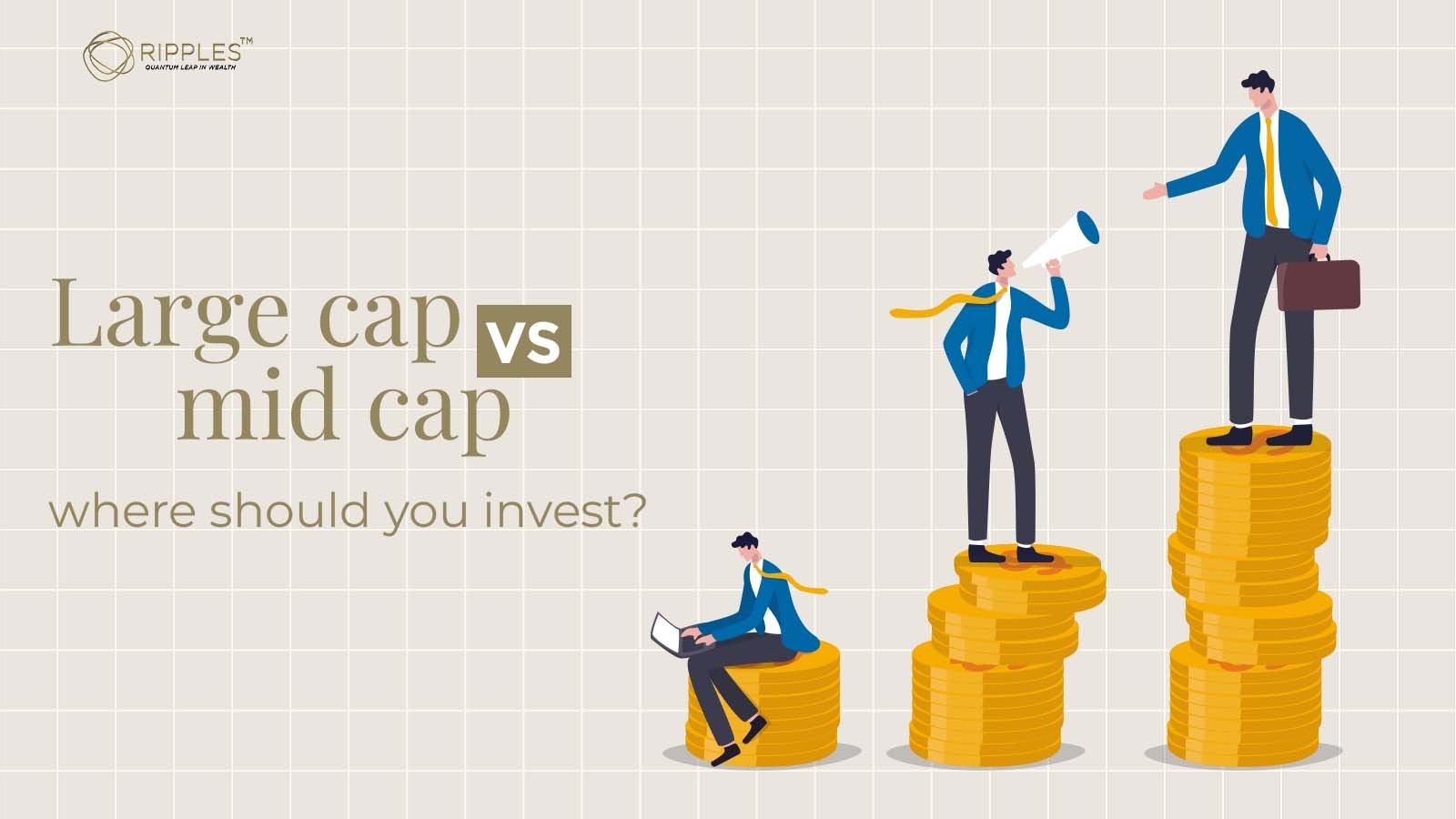
Large-cap vs mid-cap: where should you invest?
Every investor reaches this fork in the road sooner or later. You've decided to put your money into equity mutual funds, you've read about SIPs, you understand the basics, and then the real question hits you: Should I go with large-cap funds for safety, or chase the higher returns of mid-caps? It feels like choosing between sleeping peacefully and growing wealth faster. And the honest answer? It isn't quite that simple.
We'll break down exactly what separates large-cap and mid-cap funds, what the long-term data actually shows about their performance, and how to decide which one (or what mix) is a better option in 2026. Just the clarity you need to invest with confidence.
What Exactly Are Large Cap and Mid Cap Funds?
Large-cap funds invest at least 80% of their assets in the top 100 listed companies on Indian stock exchanges, ranked by full market capitalisation. These are the household names Reliance Industries, TCS, HDFC Bank, Infosys, and ITC. Companies that have already proven their business model, generate predictable cash flows, and are tracked by every institutional analyst in the country. Their market cap typically sits at ₹50,000 crore and above.
Mid-cap funds invest at least 65% of their assets in companies ranked 101st to 250th by market capitalisation. Think of these as the "next-in-line" giants. They've crossed the early-stage hurdles, established themselves, and are now in the expansion phase, large enough to be stable, small enough to still grow rapidly. Their market caps generally fall between ₹5,000 crore and ₹50,000 crore.
The Association of Mutual Funds in India (AMFI) updates this list every six months, so the companies in each bucket aren't static.
Key Differences of Large Cap vs Mid Cap Funds
Factor | Large Cap Funds | Mid Cap Funds |
Companies covered | Top 100 by market cap | Ranked 101st to 250th |
Minimum allocation | 80% in large caps | 65% in mid-caps |
Risk level | Low to moderate | Moderate to high |
Return potential | Steady, 10–12% long-term avg | Higher, 12–16% long-term avg |
Volatility | Lower drawdowns | Sharper ups and downs |
Ideal horizon | 5+ years | 7+ years |
Best for | Conservative investors, first-timers, near-retirement | Growth seekers with patience |
Examples of holdings | Reliance, HDFC Bank, TCS, Infosys | Polycab, Persistent Systems, Trent, Indian Hotels |
What the Data Actually Shows
Over long periods of 10 years or more, mid-cap indices have consistently outperformed large-cap indices in India. The Nifty Midcap 150 TRI has historically delivered 3 to 5 percentage points higher annual returns than the Nifty 50 TRI over most rolling 10-year periods in the past two decades. That gap may look small. But compounded over time? It's massive.
A simple example: A ₹10,000 monthly SIP run for 10 years would typically grow to roughly ₹20–23 lakhs in a large-cap fund (at around 10–12% returns), and ₹24–28 lakhs in a mid-cap fund (at 12–16%). That's potentially ₹5 lakhs of difference for the same effort.
But, and this is a big but, that extra return doesn't come free.
Mid-caps fall harder during market corrections. In 2008, 2011, 2018, and again in early 2025, large-cap stocks held up significantly better than their mid-cap counterparts. Mid-cap funds can deliver -25% in a bad year. Large caps usually contain damage to single digits.
So the trade-off is clear: higher long-term returns, but with the emotional cost of watching your portfolio dip more sharply along the way.
Risk Profile of Large Cap & Mid Cap
Large-cap funds are like seasoned cricketers playing a Test match. They don't smash sixes every over, but they don't get bowled out either. They fall less in corrections, recover faster, and are stress-free during global crises. When something like the COVID crash, a war, or a banking scare rattles markets, large caps cushion the blow.
Mid-cap funds are more like T20 specialists. When conditions favour them, early economic recovery, falling interest rates, and strong domestic growth, they can hand you spectacular returns. But when sentiment turns, they swing hard the other way. Liquidity dries up, valuations compress quickly, and recovery takes longer.
The rough rule: mid-caps tend to fall 1.5x to 2x as hard as large caps during a serious correction, but also rise 1.5x to 2x as fast in a recovery.
If you can stomach that emotional ride without panic-selling, mid-caps reward your patience handsomely. If you can't, the best mid-cap fund in the country won't help you because you'll exit at the bottom.
The 2026 Market Outlook: What Investors Need to Know
India's GDP is projected to grow around 6.9% in 2026. The Reserve Bank of India has room to cut rates with inflation staying soft. Government capital expenditure is set to expand significantly in FY27. Corporate earnings growth is expected at 12–16%, with some brokerages projecting up to 19%.
The Nifty 50 currently trades at a forward P/E of 20–22.8x, which is near or slightly below its 10-year average. After the stretched valuations of 2024, large caps have quietly returned to fair value without a dramatic crash. That makes them a reasonable place to be for steady compounding.
Mid-caps, meanwhile, are in what several leading fund managers are calling a sweet spot for the next two to three years. The combination of the PLI (Production Linked Incentive) scheme tailwind, improving earnings, and reasonable valuations means active fund managers have room to add alpha here genuinely. Kotak Mutual Fund's market outlook for 2026 specifically highlights mid-caps as the segment best positioned to outperform.
Who Should Invest in Large Cap Funds?
Large-cap funds make sense if you:
- Are new to equity investing and want a softer entry
- Have a 5+ year horizon but get anxious watching big drawdowns
- Are within 7–10 years of retirement and need to protect what you've built
- Want a stable foundation for your portfolio, with growth added through other categories
- Prefer predictable compounding over chasing the highest possible return
These funds are the workhorses of any sensible portfolio.
Who Should Invest in Mid-Cap Funds?
Mid-cap funds suit you if you:
- Have a long horizon of at least 7 years (ideally 10+)
- Can mentally absorb a 25–30% temporary drawdown without panicking
- Already have your emergency fund, insurance, and debt allocations sorted
- Are in your wealth-accumulation phase (typically 25–45 years old)
- Believe in India's domestic growth story and want concentrated exposure to it
If those boxes tick, mid-caps can be the single biggest wealth-creating engine in your portfolio.
A Simple Framework to Decide
1. What's your investment horizon?
- Under 5 years → Avoid both. Use debt or hybrid funds.
- 5–7 years → Lean towards large cap (70–80% of equity portion).
- 7+ years → Mix both, with a meaningful mid-cap weight (30–50%).
2. How will you react if your portfolio drops 25% next quarter?
- Sell everything → Stick with large cap.
- Worried but hold → Large & Mid Cap fund.
- See it as a buying opportunity → Add mid-cap exposure.
3. What's your age and life stage?
- 25–40, earning well → Aggressive on mid caps.
- 40–55, building corpus → 60/40 split favouring large cap.
- 55+ or close to a goal → Mostly large cap, minimal mid cap.
4. How involved do you want to be?
- "Set and forget" → Pick one Large & Mid Cap or Flexi Cap fund.
- Comfortable monitoring → Run a dedicated large cap + mid cap combination.
Tax Treatment: A Quick Note
Both large-cap and mid-cap funds are treated as equity-oriented funds for taxation in India:
- Short-term capital gains (held under 12 months) are taxed at 20%.
- Long-term capital gains (held over 12 months) up to ₹1.25 lakh per financial year are tax-free; gains above that are taxed at 12.5%.
Tax efficiency makes equity funds across both categories a structurally smart way to build long-term wealth compared to most other instruments.
Final Output
The real answer to "large cap vs mid cap" isn't a winner-takes-all verdict. It's a question of matching the fund to your horizon, your temperament, and your stage in life.
Large-cap funds give you stability and steady compounding. Mid-cap funds give you the wealth-creation engine, but only if you can ride out the volatility. And for most investors, the smartest move isn't choosing one over the other, it's owning both in proportions that reflect your goals, not generic advice.
FAQs
Which gives better returns, large-cap or mid-cap funds?
Mid-cap funds have historically delivered higher long-term returns than large-cap funds, typically 3 to 5 percentage points more annually over rolling 10-year periods. However, this higher return comes with sharper drawdowns and longer recovery periods. Large caps offer steadier, more predictable returns but with lower upside.
Are large-cap funds safer than mid-cap funds?
Yes, large-cap funds are generally less risky. They invest in well-established companies with stronger balance sheets and better liquidity, which means smaller falls during market corrections and faster recovery. Mid-caps are more volatile because the underlying companies are still in their growth phase and more sensitive to economic cycles.
Can I invest in both large-cap and mid-cap funds at the same time?
Absolutely, and most experienced investors do. Combining both gives you the stability of blue-chip companies with the growth potential of emerging leaders. You can also opt for a single Large & Mid Cap Fund (a SEBI-defined category) that maintains at least 35% in each segment, simplifying your portfolio.
What is the minimum investment horizon for mid-cap funds?
Mid-cap funds work best with a minimum horizon of 7 years, ideally 10 years or more. This timeframe allows you to ride out market corrections and benefit from the compounding of higher returns. Investing in mid-caps for less than 5 years is generally not advisable due to short-term volatility.
Should I start with a large-cap or a mid-cap as a first-time investor?
First-time investors are usually better off starting with large-cap funds. The lower volatility gives you a chance to understand how equity markets behave without facing extreme swings early on. Once you've experienced one or two market cycles and built confidence, you can gradually increase mid-cap exposure.