Key differences: Index Funds vs Active Funds
Meta Description: Index vs active funds: lower fees or higher return potential? Compare costs, risk & performance to pick the right strategy for you.
Key differences: Index Funds vs Active Funds
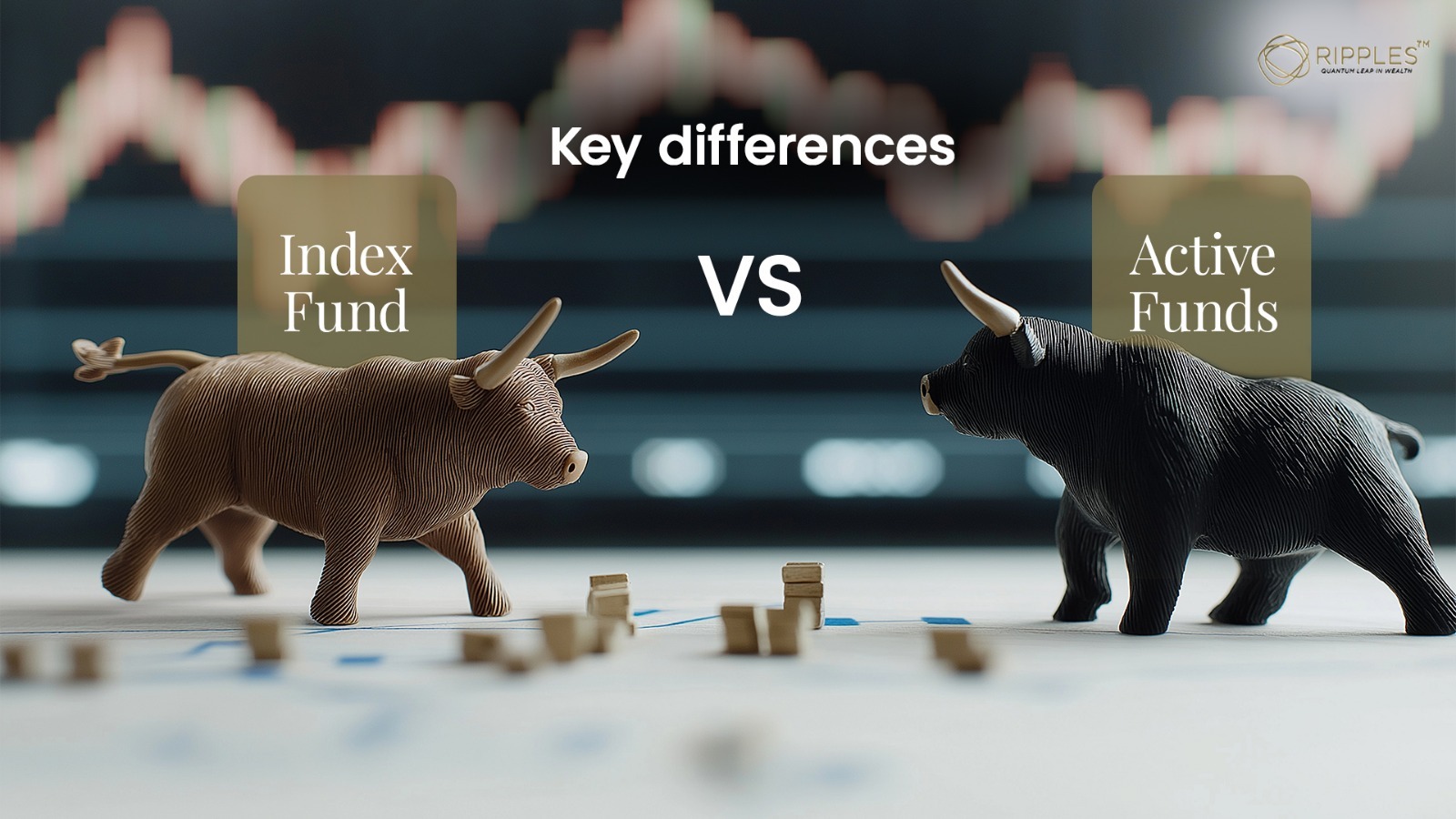
Choosing between index funds and active funds is a key decision in mutual fund investing because it directly impacts your costs, returns, and risk exposure. Index funds follow a passive investing strategy by tracking a market index at a lower expense ratio, while active funds are professionally managed to outperform the market through research and stock selection.
Understanding how they differ in strategy, fees, performance potential, and volatility can help you choose the approach that aligns best with your long-term financial goals.
What Are Index Funds?
Index funds are mutual funds or ETFs that aim to replicate the performance of a specific market index, such as the Nifty 50 or Sensex. They don’t try to beat the market. They try to mirror it.
If the index goes up by 10 percent, the index fund aims to deliver close to 10 percent, minus a small expense ratio. Because there’s no active stock picking, index funds are considered passive investing tools.
Characteristics of Index Funds
- Track a benchmark index
- Low expense ratio
- Minimal buying and selling
- Transparent portfolio
Pros and Cons of Index Funds
Advantages
- Low-cost investing
- Simple strategy
- Broad diversification
- Predictable performance relative to the index
Disadvantages
- Cannot outperform the market
- No flexibility during market downturns
- Fully exposed to market declines
What Are Active Funds?
Active funds are managed by professional fund managers who actively select stocks and bonds in an attempt to outperform the market. Here, the goal is not to match the benchmark. It’s to beat it.
The fund manager studies market trends, company performance, and economic indicators, and tries to generate higher returns than the index. This approach is called active investing.
Characteristics of Active Funds
- Fund manager-driven strategy
- Frequent buying and selling
- Higher expense ratio
- Potential to outperform the benchmark
Pros and Cons of Active Funds
Advantages
- Potential for higher returns
- Flexibility in volatile markets
- Professional fund management
Disadvantages
- Higher expense ratio
- Risk of underperformance
- Dependent on the fund manager's skill
Index Funds vs Active Funds: Core Differences
| Parameter | Index Funds (Passive Investing) | Active Funds (Active Investing) |
|---|---|---|
| Investment Strategy | Track and replicate a benchmark index. | Fund managers select stocks to outperform the benchmark. |
| Cost & Expense Ratio | Lower expense ratio due to minimal management. | Higher fees due to research and active trading. |
| Returns & Performance | Aim to match market returns. | Aim to outperform the market. |
| Risk & Volatility | Diversified and aligned with market movement. | May take concentrated bets, increasing risk. |
| Transparency | Highly transparent. | Holdings may change frequently. |
Which One is Perfect For You?
If you prefer low-cost investing, steady performance, and long-term wealth creation without constantly tracking markets, index funds may suit you.
If you believe in professional expertise and are willing to accept higher fees for the possibility of outperformance, active funds might align with your goals.
Your risk tolerance, financial goals, and time horizon should guide this decision.
Conclusion
The debate between index funds vs active funds isn’t about which one is superior in every situation. It’s about understanding how each works and choosing what fits your investment style.
Low-cost passive investing has gained massive popularity for a reason. But skilled active management can still add value in certain market conditions. The smartest move is aligning investments with your long-term financial plan.
FAQs
Are index funds safer than active funds?
Index funds are often considered less risky due to diversification, but both carry market risk.
Which has lower fees: index funds or active funds?
Index funds typically have a lower expense ratio compared to actively managed funds.
Are index funds good for beginners?
Yes. They are simple, low-cost, and ideal for long-term passive investing.
Can I switch from active funds to index funds later?
Yes, but consider tax implications, exit loads, and market timing before switching.