Difference Between CAGR vs XIRR Explained
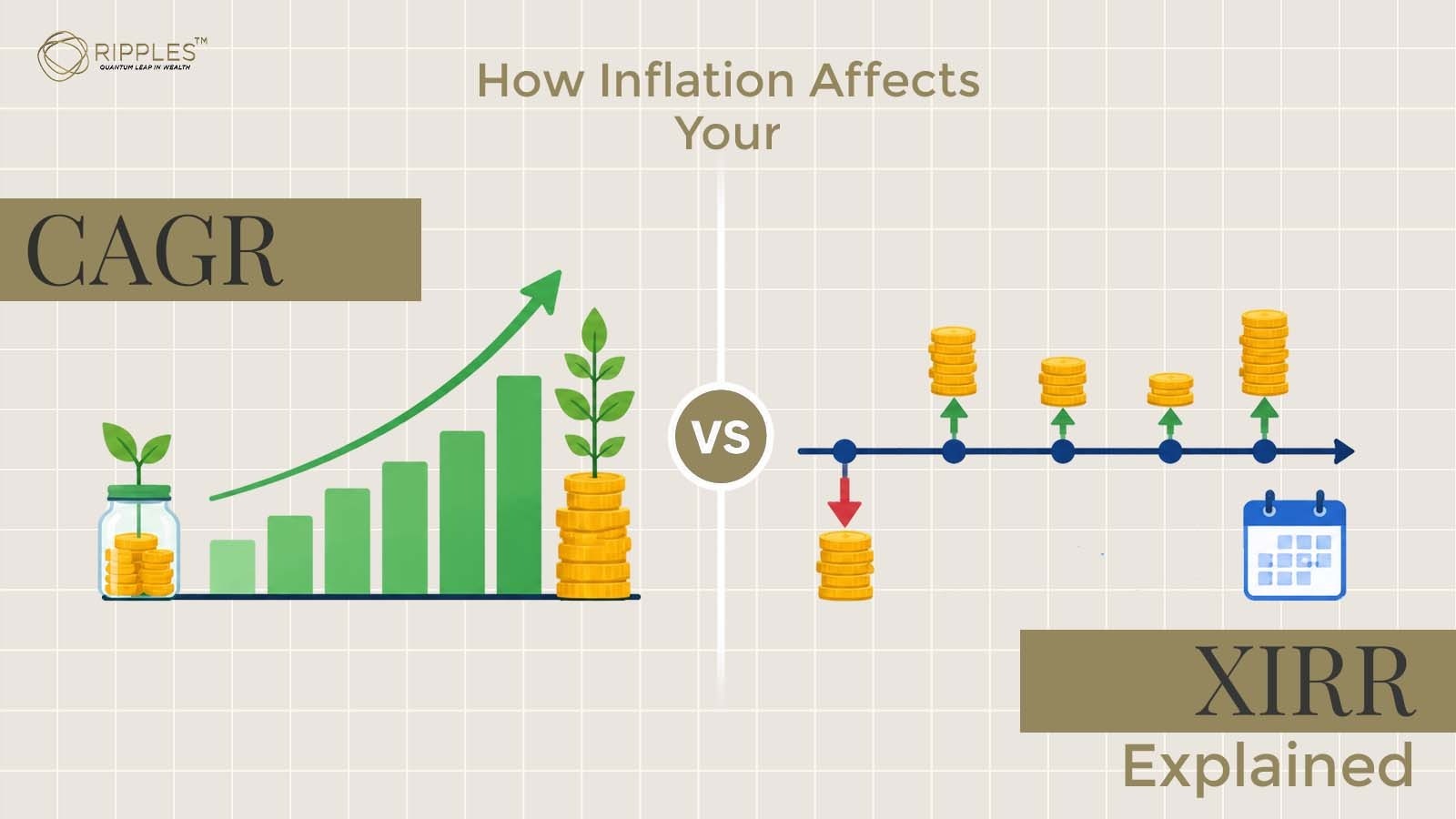
Difference Between CAGR vs XIRR Explained
Why This Difference Actually Matters
You check your mutual fund app. It shows a 5-year CAGR of 14%. Sounds solid. But you've been doing a monthly SIP, not a one-time investment. So what does that 14% actually mean for your money? Here's the uncomfortable truth: it may mean very little.
CAGR is built for lump-sum investors. If you're a SIP investor, and most Indian retail investors are applying CAGR to their portfolio, it's like using a thermometer to measure rainfall. It's not the wrong tool because itt's bad; it's the wrong tool because it was built for a different job. That's where XIRR steps in. And understanding the difference between the two can completely change how you evaluate your investments.
What is CAGR?
CAGR stands for Compound Annual Growth Rate. It tells you at what steady annual rate your investment would have grown to reach its current value, assuming you invested once, at the beginning, and let it sit.
Think of CAGR as a "smoothed" annual return. Real markets go up 20% one year and down 12% the next. CAGR irons out that volatility and gives you a single, clean number representing average annual growth.
CAGR Formula: CAGR = [(Ending Value / Beginning Value) ^ (1 / Number of Years)] – 1
Example:
- You invest 1,00,000 as a lump sum in January 2019
- By January 2024, it grows to1,85,000
- Time period: 5 years
CAGR = (1,85,000 / 1,00,000)^(1/5) – 1
= (1.85)^0.2 – 1
= 1.131 – 1
= 13.1%
Your investment grew at 13.1% per year on average. Simple, clean, and accurate for a lump-sum investment.
What CAGR Does Well
- Comparing mutual fund schemes over the same time period
- Evaluating how a stock or index has performed historically
- Benchmarking a single investment against a fixed deposit or index
- Presenting long-term fund performance in fact sheets (which is why fund houses use it)
What CAGR Cannot Do
CAGR has one critical blind spot: it assumes only one cash flow. One investment in, one value out. That's it. The moment you add a second investment, even one month later, CAGR starts losing accuracy.
What is XIRR?
XIRR stands for Extended Internal Rate of Return. It is a financial function that calculates the annualized return for investments involving multiple cash flows at irregular or different time intervals.
In simple terms, XIRR does what CAGR cannot. It looks at every single transaction you made when you invested, how much, and when you received the money back and gives you one unified annualized return.
This makes XIRR the correct metric for:
- SIP investments (monthly/quarterly contributions over years)
- Investments with partial withdrawals
- STP (Systematic Transfer Plans)
- Dividend reinvestments
- Real estate investments with staggered payments
- Any portfolio with multiple buy or sell transactions
XIRR Formula
XIRR doesn't have a simple hand-calculation formula; it works by trial and error, finding the rate r that makes the Net Present Value (NPV) of all cash flows equal to zero:
Sum of [Cash Flow(i) / (1 + r)^(days(i)/365)] = 0
Where:
- Each cash flow is either negative (investment) or positive (redemption/current value)
- Days(i) = number of days from the reference date to each transaction
- r = the rate XIRR solves for (your annualized return)
This is why XIRR is calculated in Excel or your mutual fund app. It's an iterative calculation, not a one-step formula.
Difference Between CAGR vs XIRR
Factor | CAGR | XIRR |
Full Form | Compound Annual Growth Rate | Extended Internal Rate of Return |
Best For | Lump-sum investments | SIPs, multiple investments, irregular cash flows |
Cash Flows Considered | Two only (start & end) | All transactions with exact dates |
Time Sensitivity | No (ignores interim dates) | Yes (accounts for exact investment dates) |
Complexity | Low simple formula | Higher requires Excel or a calculator |
Accuracy for SIPs | Low can mislead | High industry standard for SIP returns |
Used By | Fund houses in fact sheets | Investors & advisors for portfolio evaluation |
Handles Withdrawals? | No | Yes |
Output | Annualised % return | Annualised % return |
CAGR vs XIRR With Real Examples
Example 1: Lump-Sum Investment CAGR Works Perfectly
Ritu invests ₹5,00,000 in an equity mutual fund on 1 January 2020. On 1 January 2025, her investment is worth 9,20,000.
CAGR = (9,20,000 / 5,00,000)^(1/5) – 1 = 12.97%
CAGR tells Ritu her money grew at ~13% annually. This is accurate and meaningful because there was only one investment and one final value.
Example 2: SIP Investment CAGR Misleads, XIRR Reveals
Arjun starts a monthly SIP of ₹10,000 in January 2022. He invests for 36 months. His total investment is ₹3,60,000.
By January 2025, his portfolio is worth ₹4,80,000.
If you apply CAGR naively using the start and end values:
CAGR = (4,80,000 / 3,60,000)^(1/3) – 1 ≈ 10.06%
That seems decent. But this is wrong. Why? Because 3,60,000 wasn't invested all at once in January 2022. The first 10,000 had 36 months to grow. The last 10,000 had only 1 month. Each instalment has a different compounding period.
When Arjun runs the XIRR function in Excel with actual dates and amounts, his real XIRR comes out to approximately 15.8% significantly higher than the 10% CAGR suggested. This is why mutual fund platforms like Groww, Zerodha, and Kuvera show XIRR for SIP portfolios, not CAGR.
Example 3: SIP With a Mid-Way Withdrawal Only XIRR Can Handle It
Priya runs a ₹5,000/month SIP from 2020 to 2024. In 2022, she partially redeemed 50,000 to cover an emergency. When she checks her returns at the end of 2024, CAGR is completely useless, as it cannot account for that outflow. XIRR, however, treats the 50,000 withdrawal as a positive cash flow in 2022 and calculates a unified return across all transactions accurately.
When to Use CAGR vs XIRR
Use CAGR when:
- You invested a lump sum and want to know your annualized return
- You're comparing two mutual fund schemes over the same period (using the performance data on their fact sheets)
- You want to benchmark a fund against Nifty 50 or Sensex returns
- You're calculating how a company's revenue or earnings have grown year-on-year
Use XIRR when:
- You invest via SIP (monthly, quarterly, or any regular schedule)
- You've made multiple top-up investments over time
- You've done partial withdrawals or SWPs (Systematic Withdrawal Plans)
- You want to know the true personal rate of return on your own portfolio
- Your financial advisor is reviewing your actual investment performance
The simple rule: If your investment involved more than one transaction, use XIRR.
Why CAGR Can Mislead SIP Investors
A fund house publishes a 5-year CAGR of 16% for a popular equity fund. You've been doing a SIP in this fund for 5 years. You assume your returns are also 16%. They probably aren't, and the gap can be significant. The fund's CAGR measures the growth of 1 invested on Day 1. Your SIP contributions came in gradually; some invested for the full 5 years, some for 4 years, some for 1 year. Each rupee had a different growth runway.
Depending on when the market was high or low during your SIP tenure, your personal XIRR could be higher or lower than the published CAGR. Neither number is wrong they're measuring different things. This is why investors sometimes feel cheated: The fund showed 16% CAGR, but my returns are only 11%." In most cases, this isn't fund underperformance, it's a metric mismatch. Always compare your XIRR with the fund's XIRR (not CAGR) for an apples-to-apples comparison of your SIP performance.
How to Calculate XIRR in Excel
Excel makes this straightforward. Here's a step-by-step method:
Step 1: List all your investment dates in Column A and amounts in Column B.
- Investment amounts should be negative (money going out of your pocket)
- The current portfolio value on today's date should be positive (money coming back to you)
Example:
Date | Amount (₹) |
01-01-2022 | -10,000 |
01-02-2022 | -10,000 |
01-03-2022 | -10,000 |
... | ... |
01-01-2025 | +4,80,000 |
Step 2 In an empty cell, type:
=XIRR(B2:B38, A2: A38)
Step 3: Excel returns a decimal. Multiply by 100 to get your percentage return.
Pro Tip: If XIRR gives you an error, ensure all date cells are in date format (not text) and that you have at least one negative and one positive value in your cash flow column.
Which is better, CAGR or XIRR?
Neither is universally better. They're designed for different situations. CAGR is better when you need a quick, clean comparison of a fund's historical performance or when evaluating a lump-sum investment. XIRR is better when you need to know what your money actually earned, accounting for every rupee you put in and when you put it in.
For most retail investors in India who invest primarily through SIPs, XIRR is the more personally relevant metric. It reflects your actual investment experience, not a theoretical scenario. A good XIRR for equity mutual funds in India is generally considered to be 12% or above over a 5-year horizon. For debt funds, 7–8% XIRR is a reasonable benchmark.
Conclusion
CAGR and XIRR are both valid; they just answer different questions.
CAGR answers: "How did this fund perform if you invested once and held?"
XIRR answers: "What did your money actually earn, given exactly when and how much you invested?"
If you're a SIP investor, which most of us are, make XIRR your default lens for evaluating portfolio performance. Reserve CAGR for comparing funds or tracking a lump-sum investment. Understanding these two metrics won't just make you a more informed investor. It'll stop you from comparing the wrong numbers and making decisions based on a metric that was never meant for your situation.
Invest in a mutual fund basket with Ripples
FAQs
1. Can XIRR and CAGR give the same result?
Yes, but only in one specific scenario: when you make a single lump-sum investment with no intermediate cash flows. In that case, XIRR and CAGR will produce identical results. As soon as you add a second transaction, they diverge.
2. Why does my mutual fund app show XIRR and not CAGR for my SIP?
Because XIRR is the correct metric for SIP investments, your app is showing you the actual annualized return on your personal investment, accounting for when you invested each instalment. Fund fact sheets show CAGR for the fund's overall performance your personal return can differ.
3. Is a higher XIRR always better than a higher CAGR?
You can't directly compare XIRR and CAGR numbers against each other because they measure different things. Compare XIRR with XIRR and CAGR with CAGR. When benchmarking your SIP returns, compare your XIRR with the fund's XIRR (available from platforms like Value Research or the AMC website).
4. What is a good XIRR for a mutual fund SIP?
For equity mutual funds, an XIRR of 12–15% over a 5-year period is generally considered good. For hybrid funds, 9–12% is reasonable. For debt funds, 7–8.5% is a fair benchmark. Always measure against inflation (currently 4–6% in India) and your personal financial goals.
5. Can I use XIRR to calculate returns on real estate or other investments?
Absolutely. XIRR works for any investment with multiple cash flows and specific dates rental income, property purchase costs, renovation expenses, and eventual sale proceeds can all be entered into the XIRR function to calculate your real estate investment's annualized return.
6. Why is CAGR used in mutual fund fact sheets if XIRR is more accurate?
Fund fact sheets use CAGR because they need to show a standardized, comparable figure for a ₹10,000 lump-sum investment made on a specific date. This allows investors to compare different funds on equal terms. It's a benchmark metric, not a personalized one. For your own portfolio evaluation, XIRR is always more meaningful.